


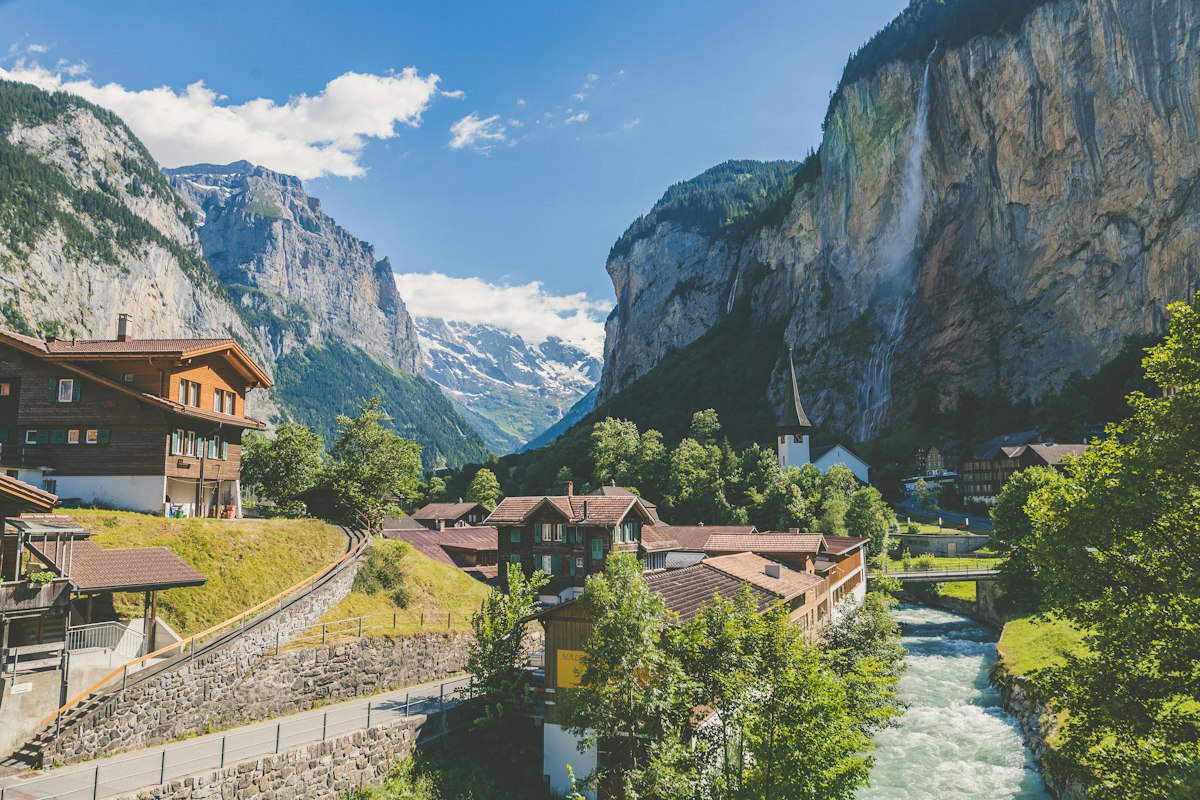
TL;DR: Switzerland is one of the most photogenic countries on earth, with dramatic alpine scenery, mirror-still lakes, medieval villages, and epic light conditions. The best photo times are golden hour (30-60 minutes after sunrise and before sunset), which varies dramatically by season (5:30am in June vs. 8:00am in December). Drones are legal in Switzerland with specific restrictions (no-fly zones, 120 m max altitude, visual line of sight). This guide covers the best spots by region, seasonal light data, drone rules, and the weather apps that Swiss landscape photographers swear by.
Quick Answer
The single most photogenic region in Switzerland is the Bernese Oberland (Grindelwald, Lauterbrunnen, Interlaken), where the Eiger-Monch-Jungfrau trilogy provides an endless backdrop. The most iconic individual shot is the Matterhorn reflected in Riffelsee or Stellisee (accessible from Zermatt). For Instagram-worthy locations, Iseltwald jetty on Lake Brienz, the Landwasser Viaduct, and the Lauterbrunnen Valley are the current most-photographed spots. September offers the best combination of clear skies, golden larch colors, and lower crowds.
Table of Contents
- Best Photo Spots by Region
- Golden Hour and Seasonal Light
- Instagram-Worthy Locations — The Top 25
- Drone Regulations in Switzerland
- Tripod-Friendly Viewpoints
- Sunrise and Sunset Spots
- Milky Way and Astrophotography
- Weather Apps for Photographers
- Seasonal Photography Calendar
- Camera Gear Recommendations
- Insider Tips
- Frequently Asked Questions
Best Photo Spots by Region {#spots-by-region}
Bernese Oberland
The most diverse and dramatic photography region in Switzerland. The trilogy of Eiger (3,967 m), Monch (4,107 m), and Jungfrau (4,158 m) provides an ever-changing backdrop, while deep valleys, turquoise lakes, and waterfalls complete the scene.
| Spot | What to Shoot | Access | Best Time | GPS |
|---|---|---|---|---|
| Mannlichen panorama | Eiger-Monch-Jungfrau sunrise | Gondola from Wengen (CHF 54 return) or hike from Grindelwald | Sunrise (arrive 30 min before) | 46.6124N, 7.9393E |
| Lauterbrunnen Valley (from Staubbach viewpoint) | 72 waterfalls, valley floor | Walk into valley from Lauterbrunnen station | Morning (sun hits valley 9-10am) | 46.5934N, 7.9075E |
| Bachalpsee | Mountain reflections (Schreckhorn, Wetterhorn) | First gondola + 50 min hike | Sunrise or early morning (still water) | 46.6708N, 8.0243E |
| Oeschinensee | Turquoise lake with Blüemlisalp | Gondola from Kandersteg + 20 min walk | Morning (direct sun 9-11am) | 46.4977N, 7.7259E |
| Schynige Platte | Alpine flowers with Eiger backdrop | Cog railway from Wilderswil | June-July (peak flower season) | 46.6545N, 7.9045E |
| Lake Brienz (Iseltwald) | Turquoise lake, famous jetty | Train to Iseltwald | Morning (soft light) | 46.7255N, 7.9639E |
| Harder Kulm | Interlaken and both lakes from above | Funicular from Interlaken (CHF 40) | Sunset | 46.6998N, 7.8643E |
| Giessbach Falls | 500 m waterfall with Grand Hotel | Boat from Brienz (free with STP) | Afternoon (sun on falls) | 46.7375N, 7.9795E |
Valais (Zermatt and Beyond)
Home to the Matterhorn — arguably the world's most recognizable mountain.
| Spot | What to Shoot | Access | Best Time | GPS |
|---|---|---|---|---|
| Riffelsee | Matterhorn reflection (THE classic shot) | Gornergrat railway to Rotenboden (CHF 118 return, 50% STP) | Sunrise, calm mornings | 46.0017N, 7.7693E |
| Stellisee | Matterhorn reflection (less crowded than Riffelsee) | Sunnegga funicular + 40 min hike | Sunrise | 46.0127N, 7.7701E |
| Gornergrat (3,089 m) | Monte Rosa massif, Gorner Glacier panorama | Gornergrat railway from Zermatt | Sunrise or sunset | 45.9836N, 7.7859E |
| Findelgletscher viewpoint | Glacier landscape with Matterhorn | Sunnegga + hike to Findeln | Afternoon (warm light on glacier) | 46.0050N, 7.7900E |
| Sunnegga to Leisee | Matterhorn reflection in tiny lake | Sunnegga funicular (CHF 24 return) + 5 min walk | Morning | 46.0145N, 7.7538E |
| Bettmeralp/Riederalp | Aletsch Glacier from above | Cable car from Brig valley | Afternoon (sun on glacier) | 46.3923N, 8.0574E |
| Lavaux vineyards | Terraced vineyards over Lake Geneva | Walk from Lutry (train from Lausanne 10 min) | Sunset (golden light on vines) | 46.4951N, 6.7377E |
Central Switzerland
Lake Lucerne and its surrounding peaks create some of the most atmospheric shots in the country.
| Spot | What to Shoot | Access | Best Time | GPS |
|---|---|---|---|---|
| Chapel Bridge (Kapellbrücke) | Iconic covered bridge with Water Tower | Lucerne city center | Blue hour (30 min after sunset) | 47.0516N, 8.3079E |
| Pilatus summit (2,128 m) | Sea of clouds (Nebelmeer) above fog | Cogwheel railway or cable car | Autumn mornings (when lowland fog present) | 46.9787N, 8.2535E |
| Rigi (1,798 m) | Sunrise above fog, lake panorama | Cogwheel from Vitznau or Arth-Goldau | Sunrise (stay overnight at Rigi Kulm Hotel) | 47.0565N, 8.4852E |
| Lake Lucerne paddle steamer | Historic ships on mountain lake | SGV boat from Lucerne (free with STP) | Late afternoon (golden light, quiet water) | 46.9880N, 8.4330E |
| Stoos ridge | Fronalpstock panorama, 10 Swiss lakes visible | Funicular from Schwyz (world's steepest, 110%) | Clear day, morning | 46.9780N, 8.6636E |
Ticino
Mediterranean light meets alpine drama — a unique combination.
| Spot | What to Shoot | Access | Best Time | GPS |
|---|---|---|---|---|
| Verzasca Dam (Contra) | James Bond bungee jump location, turquoise river | Bus from Locarno or drive | Morning (sun on dam face) | 46.2192N, 8.8350E |
| Lavertezzo bridge (Ponte dei Salti) | Roman double arch bridge, emerald pools | Bus from Locarno to Lavertezzo | Late morning-afternoon (sun on pools) | 46.2736N, 8.8462E |
| Ascona lakeside | Pastel-colored promenade, Lake Maggiore | Walk from Locarno or boat | Sunset | 46.1549N, 8.7728E |
| Monte Bre (Lugano) | City, lake, and mountain panorama | Funicular from Cassarate (CHF 30, 50% STP) | Sunset | 46.0149N, 8.9864E |
| Morcote | Lakeside village with church tower | Boat from Lugano (free with STP) | Late afternoon | 45.9235N, 8.9122E |
Graubünden (Engadin and Eastern Alps)
Pristine alpine landscapes with exceptional light quality.
| Spot | What to Shoot | Access | Best Time | GPS |
|---|---|---|---|---|
| Landwasser Viaduct | Iconic curved railway bridge into tunnel | Hike from Filisur (30 min) or viewpoint | When train passes (check RhB timetable) | 46.6805N, 9.6746E |
| Lake Silvaplana | Engadin light, mountain reflections | Roadside or walk from Silvaplana village | Morning (mirror reflections) | 46.4477N, 9.7935E |
| Muottas Muragl (2,456 m) | Upper Engadin lakes panorama | Funicular from Punt Muragl (CHF 48, 50% STP) | Sunset or clear night (astrophotography) | 46.4926N, 9.9473E |
| Morteratsch Glacier | Glacier snout, Bernina massif | Walk from Morteratsch station (50 min) | Morning or late afternoon | 46.4300N, 9.9303E |
| Caumasee (Flims) | Crystal-clear turquoise alpine lake | Elevator from Flims + 15 min walk | Morning (calm water, minimal swimmers) | 46.8276N, 9.2732E |
Appenzell and Eastern Switzerland
Rolling green hills, traditional architecture, and the dramatic Santis massif.
| Spot | What to Shoot | Access | Best Time | GPS |
|---|---|---|---|---|
| Seealpsee | Alpine lake with Santis peak | Hike from Wasserauen (1h 15min) | Early morning (reflections) | 47.2499N, 9.3658E |
| Aescher Guesthouse (Wildkirchli) | Cliff-face mountain restaurant | Ebenalp cable car + 15 min walk | Afternoon (dramatic side light) | 47.2819N, 9.4102E |
| Rhine Falls | Europe's largest waterfall by volume | Train to Neuhausen (52 min from Zurich) | After rain (maximum water flow) | 47.6775N, 8.6150E |
Golden Hour and Seasonal Light {#golden-hour}
Sunrise and Sunset Times by Season (Zurich Reference, 2026)
| Month | Sunrise | Sunset | Golden Hour Duration | Best For |
|---|---|---|---|---|
| January | 08:05 | 16:50 | ~40 min each | Winter mist, snow scenes |
| February | 07:30 | 17:35 | ~45 min each | Snow-covered peaks, clear skies |
| March | 06:40 | 18:20 | ~45 min each | Spring light, last snow |
| April | 06:35 (after DST) | 20:05 | ~50 min each | Wildflowers, waterfalls at peak |
| May | 05:50 | 20:45 | ~50 min each | Green alps, long days |
| June | 05:30 | 21:20 | ~55 min each | Longest days, alpine flowers |
| July | 05:45 | 21:15 | ~55 min each | Peak season, warm light |
| August | 06:20 | 20:40 | ~50 min each | Warm tones, stable weather |
| September | 07:00 | 19:45 | ~45 min each | Golden larches, harvest |
| October | 07:40 | 18:35 | ~45 min each | Autumn color, fog in valleys |
| November | 07:25 | 16:50 | ~40 min each | Dramatic fog, short days |
| December | 08:00 | 16:35 | ~35 min each | Christmas lights, snow |
Note: Mountain sunrise/sunset differs from city times. At altitude, you gain approximately 2-5 minutes of earlier sunrise and later sunset per 1,000 m. Mountains to the east may delay sunrise in valleys.
Best Light Conditions by Season
| Season | Light Quality | Photography Opportunities |
|---|---|---|
| Winter (Dec-Feb) | Low sun angle, warm tones, dramatic shadows | Nebelmeer (sea of clouds above fog), snow landscapes, Christmas markets, alpenglow on peaks |
| Spring (Mar-May) | Soft, clean light after rain | Waterfalls at peak flow, wildflowers, green valleys with snow-capped peaks |
| Summer (Jun-Aug) | Long golden hours, high sun midday | Alpine flowers, mountain reflections in lakes, thunderstorm skies |
| Autumn (Sep-Nov) | Warm tones, frequent temperature inversions | Golden larch forests (Lötschental, Engadin), fog in valleys, clear mountain air |
The Nebelmeer (Sea of Clouds)
One of Switzerland's most spectacular photographic phenomena. In autumn and winter, cold air and fog settles in the Swiss Plateau (Mittelland), while mountains above 800-1,200 m bask in sunshine above a flat cloud layer — the "Nebelmeer" (sea of fog).
Best Nebelmeer locations:
- Rigi (1,798 m) — the classic viewpoint, stay overnight for sunrise
- Pilatus (2,128 m) — dramatic above-cloud panorama
- Uetliberg (871 m) — closest to Zurich, accessible by S-Bahn
- Niesen (2,362 m) — above Lake Thun
- Weissenstein (1,284 m) — Jura chain, above Solothurn
When: October through February, especially after clear, cold nights following a rainy period. Check MeteoSwiss for fog forecasts (Nebel in the forecast for the Mittelland = potential Nebelmeer above).
Instagram-Worthy Locations — The Top 25 {#instagram-spots}
| Rank | Location | Region | Why It Works | Difficulty to Access |
|---|---|---|---|---|
| 1 | Lauterbrunnen Valley | Bernese Oberland | 72 waterfalls, dramatic valley | Easy (train) |
| 2 | Matterhorn from Riffelsee | Zermatt | Perfect mountain reflection | Moderate (railway + walk) |
| 3 | Iseltwald jetty (Lake Brienz) | Bernese Oberland | Turquoise lake, wooden jetty | Easy (train) |
| 4 | Landwasser Viaduct | Graubünden | Curved bridge into tunnel | Moderate (30 min hike) |
| 5 | Chapel Bridge, Lucerne | Central Switzerland | Medieval bridge, lake mountains | Easy (city center) |
| 6 | Bachalpsee | Bernese Oberland | Mountain reflections at 2,265 m | Moderate (gondola + hike) |
| 7 | Oeschinensee | Bernese Oberland | Turquoise alpine lake | Moderate (gondola + walk) |
| 8 | Lavertezzo bridge (Verzasca) | Ticino | Roman bridge, emerald pools | Easy (bus) |
| 9 | Blausee | Kandertal | Crystal-clear blue lake | Easy (bus/car) |
| 10 | Bern Old Town (Rosengarten view) | Bern | UNESCO town in river bend | Easy (walk) |
| 11 | Lavaux vineyards | Lake Geneva | Terraced vineyards, lake | Easy (train + walk) |
| 12 | Aescher Guesthouse | Appenzell | Cliff-face restaurant | Moderate (cable car + walk) |
| 13 | Seealpsee | Appenzell | Alpine lake with Santis | Moderate (1h hike) |
| 14 | Rhine Falls | Schaffhausen | Europe's largest waterfall | Easy (train) |
| 15 | Grindelwald First Cliff Walk | Bernese Oberland | Glass walkway, Eiger views | Easy (gondola) |
| 16 | Morcote | Ticino | Lakeside village | Easy (boat) |
| 17 | Chateau de Chillon | Lake Geneva | Medieval castle on water | Easy (bus/boat) |
| 18 | Gorner Gorge | Zermatt | 64 m deep gorge | Easy (walk) |
| 19 | Creux du Van | Neuchâtel | 160 m rock amphitheater | Moderate (4.5h hike) |
| 20 | Caumasee | Flims | Warm turquoise lake in forest | Easy (elevator + walk) |
| 21 | Lake Silvaplana | Engadin | Engadin light, reflections | Easy (roadside) |
| 22 | Spiez Castle | Lake Thun | Castle on lake peninsula | Easy (train) |
| 23 | Jet d'Eau | Geneva | 140 m water fountain | Easy (lakeside) |
| 24 | Stoos village | Central Switzerland | Car-free alpine village | Easy (funicular) |
| 25 | Zermatt village with Matterhorn | Zermatt | Traditional chalets, mountain | Easy (main street) |
Drone Regulations in Switzerland {#drone-rules}
Key Rules (EASA/FOCA Regulations, 2026)
Switzerland follows EASA (European Union Aviation Safety Agency) drone regulations, enforced by FOCA (Federal Office of Civil Aviation).
| Rule | Requirement |
|---|---|
| Registration | Mandatory for drones 250g+. Register at easa.europa.eu or via FOCA. Operators need a UAS Operator Number. |
| Maximum altitude | 120 m above ground level (AGL) in the Open Category |
| Visual line of sight | Mandatory at all times. No beyond-visual-line-of-sight (BVLOS) without special authorization. |
| Distance from people | Minimum 30 m horizontal distance from uninvolved persons (C1/C2 class drones). 150 m from assemblies of people. |
| Insurance | Mandatory third-party liability insurance for all drones. |
| No-fly zones | Within 5 km of airports/aerodromes (Zurich, Geneva, Basel, Bern, Lugano, Sion airports and many regional airfields). Check map.geo.admin.ch for current zones. |
| National parks | Drones prohibited in the Swiss National Park (Engadin). |
| Nature reserves | Many nature reserves prohibit drones. Check local signs and cantonal regulations. |
| Military zones | Prohibited. Shown on FOCA maps. |
| Over crowds | Prohibited without specific authorization (Open Category). |
Where You CAN Fly (and Get Great Footage)
| Location | Flyable? | Notes |
|---|---|---|
| Lauterbrunnen Valley | Yes (with restrictions) | Away from the helipad and paragliders. Respect privacy. |
| Mountain summits (remote) | Generally yes | Check for wildlife protection zones and military areas. |
| Lake shores (remote) | Generally yes | Away from harbors, boats, and crowds. |
| Lavaux vineyards | Restricted | Close to Lausanne airport flight path. Check geo.admin.ch. |
| Zermatt area | Partially | Helicopter traffic is frequent. Respect airspace. |
| Over cities | Restricted | Most city centers have gathering zones and restricted airspace. |
| Swiss National Park | No | Completely prohibited. |
Pre-Flight Checklist
- Check no-fly zones on map.geo.admin.ch (search "Drohnenkarte" / "drone map")
- Check weather — wind conditions change rapidly at altitude
- Ensure battery capacity accounts for cold temperatures (batteries lose 20-40% capacity below 0 degrees C)
- Register and display your operator number
- Carry proof of insurance
- Respect privacy — do not fly over private property at low altitude
Tripod-Friendly Viewpoints {#tripod-viewpoints}
| Viewpoint | Location | What You Shoot | Tripod Space | Access |
|---|---|---|---|---|
| Riffelsee platform | Zermatt | Matterhorn reflection | Wide open area | Railway + 10 min walk |
| Harder Kulm Zwei-Seen-Steg | Interlaken | Two lakes, Jungfrau | Bridge platform, narrow | Funicular |
| Mannlichen summit platform | Grindelwald/Wengen | Eiger-Monch-Jungfrau | Wide ridge, spacious | Gondola |
| Muottas Muragl terrace | Engadin | Lakes panorama | Hotel terrace, spacious | Funicular |
| Pilatus summit | Central Switzerland | 73 alpine peaks | Multiple platforms | Cogwheel/cable car |
| Gorner Glacier viewpoint | Zermatt | Glacier panorama from Gornergrat | Wide observation deck | Railway |
| Landwasser Viaduct viewpoint | Filisur | Train crossing viaduct | Dedicated platform | 30 min hike |
| Schilthorn Piz Gloria | Murren | 360-degree revolving platform | Indoor/outdoor | Cable car |
| Niederhorn terrace | Beatenberg | Lake Thun and Bernese Alps | Wide terrace | Funicular |
| Gemmi Pass | Leukerbad | Dramatic cliff drop, Dauben Lake | Open landscape | Cable car + walk |
Sunrise and Sunset Spots {#sunrise-sunset}
Best Sunrise Spots
| Spot | Altitude | What You See | How to Get There for Sunrise |
|---|---|---|---|
| Rigi Kulm | 1,798 m | Sea of clouds, Alps, 3 lakes | Stay overnight at Rigi Kulm Hotel (CHF 150-250) |
| Gornergrat | 3,089 m | Monte Rosa, Matterhorn at first light | Stay at 3100 Kulm Hotel Gornergrat (highest hotel in Alps) |
| Mannlichen | 2,343 m | Eiger-Monch-Jungfrau in alpenglow | Take first gondola (summer: ~6:30am from Grindelwald) |
| Pilatus | 2,128 m | Central Swiss Alps above fog | Stay at Hotel Pilatus-Kulm (CHF 200-350) |
| Brienzer Rothorn | 2,350 m | Lake Brienz, Bernese Alps | Stay at mountain hotel or take first steam train |
| Fronalpstock (Stoos) | 1,922 m | 10 Swiss lakes | Take first funicular from Schwyz |
Best Sunset Spots
| Spot | Altitude | What You See | Access |
|---|---|---|---|
| Harder Kulm | 1,322 m | Golden light on Jungfrau, two lakes | Funicular, last descent ~9pm summer |
| Lavaux vineyards | 400-600 m | Sunset over Lake Geneva | Walk from any village |
| Uetliberg | 871 m | Zurich, lake, and Alps in evening light | S10 train, 20 min from Zurich |
| Niesen (Pyramid) | 2,362 m | Lake Thun and Bernese Alps | Funicular from Mulenen (last descent ~6pm summer) |
| Monte Bre | 925 m | Sunset over Lake Lugano | Funicular from Cassarate |
| Cardada (Locarno) | 1,340 m | Lake Maggiore sunset | Cable car from Locarno |
Milky Way and Astrophotography {#milky-way}
Best Conditions
The Milky Way core is visible in Swiss skies from approximately March through October, with the best visibility from June to September when the core is highest in the sky. The key requirements are:
- New moon or thin crescent (check moon phase calendars)
- Clear skies (check MeteoSwiss)
- High altitude (less atmosphere = clearer stars)
- Minimal light pollution (avoid cities)
Best Astrophotography Locations
| Location | Altitude | Light Pollution | Bortle Scale | How to Access |
|---|---|---|---|---|
| Muottas Muragl (Engadin) | 2,456 m | Very low | 2-3 | Funicular (arrange late descent or overnight) |
| Gornergrat (Zermatt) | 3,089 m | Very low | 2 | Railway (overnight at hotel) |
| Swiss National Park (Engadin) | 1,500-2,500 m | Extremely low | 1-2 | Hike to valley (Trupchun, Val Cluozza) |
| Grimsel Pass | 2,165 m | Low | 3 | Drive or PostBus (summer only) |
| Furka Pass | 2,429 m | Very low | 2-3 | Drive or PostBus (summer only) |
| Sustenpass | 2,224 m | Low | 3 | Drive or PostBus (summer only) |
| Julierpass (Engadin) | 2,284 m | Low | 3 | Drive or PostBus |
| Bachalpsee (Grindelwald) | 2,265 m | Low | 3-4 | Hike from First (camp) |
Settings Guide for Alpine Night Photography
| Subject | Aperture | Shutter Speed | ISO | Focal Length | Notes |
|---|---|---|---|---|---|
| Milky Way (wide) | f/1.4-2.8 | 15-25 sec | 3200-6400 | 14-24mm | Use 500-rule for max exposure |
| Star trails | f/2.8-4 | 30 sec (stacked) | 1600-3200 | 14-35mm | Stack 100+ images |
| Moonlit mountains | f/4-5.6 | 15-30 sec | 1600-3200 | 24-70mm | Full moon lights peaks |
| Northern Lights (rare) | f/1.4-2.8 | 5-15 sec | 1600-6400 | 14-24mm | Occasionally visible from N. Switzerland during strong events |
Weather Apps for Photographers {#weather-apps}
| App | Platform | Cost | Best For |
|---|---|---|---|
| MeteoSwiss | iOS, Android | Free | Official Swiss weather, mountain forecasts, precipitation radar |
| MeteoBlue | iOS, Android, Web | Free/Premium | Detailed cloud cover forecasts, multi-model comparison, visibility forecast |
| Windy | iOS, Android, Web | Free | Wind visualization, cloud layer forecasts, satellite imagery |
| Clear Outside | iOS, Android, Web | Free | Astronomy-focused: cloud cover, seeing, transparency |
| PhotoPills | iOS, Android | CHF 12 (one-time) | Sun/moon position, Milky Way planner, golden/blue hour calculator |
| The Photographer's Ephemeris (TPE) | iOS, Android | CHF 10 | Sun/moon rise/set positions on a map, light direction planning |
| PeakFinder | iOS, Android | CHF 5 | Identifies every visible peak from your camera position |
| swisstopo | iOS, Android | Free | Topographic maps (1:25,000) for viewpoint planning |
| SBB Mobile | iOS, Android | Free | Train schedules to photo locations |
Weather Strategy for Photographers
- Check MeteoSwiss the night before for the next day's forecast. The mountain forecast (Bergwetter) gives cloud height, wind, and temperature at altitude.
- Use MeteoBlue's meteogram for hour-by-hour cloud cover predictions. This shows when breaks in clouds are expected.
- For sunrise shoots, check the fog forecast. MeteoSwiss shows fog height — if fog is predicted at 800 m and your viewpoint is at 1,500 m, you will be above the clouds (Nebelmeer).
- The best light often comes after storms. Check the rain radar; as fronts pass, the clearing sky creates dramatic light.
- Wind direction matters for reflections. Lake reflections require calm water. Check wind forecasts — mornings are usually calmer than afternoons (thermals develop after 10-11am).
Seasonal Photography Calendar {#seasonal-calendar}
| Month | What to Photograph | Where |
|---|---|---|
| January | Snow landscapes, frozen lakes, Nebelmeer | Engadin, Rigi, any alpine pass |
| February | Carnival (Fasnacht), deep snow, clear skies | Basel (Fasnacht), Bernese Oberland |
| March | Last winter snow, first crocuses, Milky Way returns | Any mountain, valley edges |
| April | Cherry blossoms, waterfalls beginning to swell, green valleys | Basel, Zug, Ticino (early spring) |
| May | Waterfalls at peak, wildflowers, green alps | Lauterbrunnen, Rhine Falls, alpine meadows |
| June | Alpine flowers at peak, longest days, late sunset | Schynige Platte, any alpine meadow, Lavaux |
| July | High alpine access, Milky Way core, thunderstorm skies | Bernina Pass, Grimsel, Matterhorn |
| August | Warm light, stable weather, alpine lakes accessible | All locations, National Day fireworks (Aug 1) |
| September | Golden larches, autumn color, clear air, fewer tourists | Lötschental, Engadin, Lauterbrunnen |
| October | Fog season begins (Nebelmeer), autumn color in valleys | Rigi, Pilatus, Uetliberg (above fog) |
| November | Dramatic fog, early snow on peaks, moody skies | Any viewpoint above 800 m |
| December | Christmas markets, snow villages, shortest days (dramatic light) | Basel, Bern, Montreux, alpine villages |
The golden larch season (September-October) is one of Switzerland's most photogenic events. European larches (Larix decidua) are the only alpine conifer that loses its needles, turning a brilliant gold before dropping. The best larch forests are in:
- Lotschental (Valais) — the Lauchernalp area
- Upper Engadin — around Morteratsch and Val Roseg
- Aletsch Forest — Europe's highest larch forest at 2,000 m
- Derborence (Valais) — ancient forest with golden larches
Camera Gear Recommendations {#gear}
Essential Kit for Swiss Mountain Photography
| Item | Recommendation | Notes |
|---|---|---|
| Camera body | Full-frame mirrorless (Sony A7 series, Nikon Z, Canon R) | Full-frame excels in low light for sunrise/astro |
| Wide-angle lens | 14-24mm f/2.8 or 16-35mm f/4 | Essential for mountain panoramas and astrophotography |
| Mid-range zoom | 24-70mm f/2.8 or f/4 | Versatile for landscapes and villages |
| Telephoto | 70-200mm f/4 | Compression of mountain layers, wildlife, detail shots |
| Tripod | Carbon fiber, travel size | Essential for sunrise/sunset/astro; carbon handles cold better |
| Filters | Circular polarizer, ND grad (3-stop soft) | CPL for lake reflections and sky contrast; ND grad for sky/land exposure balance |
| Spare batteries | 3-4 batteries minimum | Cold reduces battery life by 30-50%. Keep spares warm in your pocket. |
| Memory cards | 128GB+ fast cards | Shoot RAW for maximum editing flexibility |
| Lens cloth | Microfiber + lens pen | Fog and moisture are constant at altitude |
| Backpack | Weather-resistant camera backpack (30-40L) | Must be comfortable for 2-4 hour hikes |
Insider Tips
September is the photographer's month. Clear air after summer haze, golden larch forests, fewer tourists, stable weather patterns, and the Nebelmeer season beginning. If you can only visit once for photography, make it mid-September to mid-October.
The Landwasser Viaduct has a dedicated photo platform. The official viewpoint is a 30-minute walk from Filisur station. Check the RhB train timetable to know exactly when trains will cross the viaduct — they pass approximately every 30 minutes.
For Matterhorn reflections, go to Stellisee instead of Riffelsee. Riffelsee is closer to the railway and more accessible, so it is crowded. Stellisee requires a 40-minute hike from Sunnegga but is quieter and equally photogenic. Go for sunrise.
Use PhotoPills to plan the exact sun/moon position. This app lets you simulate where the sun and Milky Way will be at any location, date, and time. Essential for planning compositions.
Mountain weather changes in 30 minutes. A clear morning can become a thunderstorm by 2pm. Start early, shoot at sunrise, and be prepared for everything. Dramatic cloud buildups often produce the most spectacular images.
Carry a microfiber cloth and lens pen obsessively. Alpine air is humid, and hiking generates body heat that fogs your lens the moment you stop. Clean your lens before every shot.
The Swiss Travel Pass turns Lake Lucerne boats into photography platforms. The paddle steamers have open rear decks — perfect for shooting the mountain scenery from the water with a tripod. Free with STP.
Autumn fog + altitude viewpoint = guaranteed dramatic shot. When MeteoSwiss forecasts fog (Nebel) in the Swiss Plateau, grab a train to Rigi, Pilatus, or Uetliberg. The Nebelmeer (sea of clouds) lit by sunrise is one of Switzerland's most spectacular visual phenomena.
Iseltwald jetty now charges CHF 5 for access. Due to extreme Instagram tourism after a Korean TV show, the village implemented a toll. Go early morning to avoid crowds and get the best light.
Do not underestimate smartphone photography in Switzerland. Modern smartphones produce excellent landscape images, especially in good light. Swiss light quality is exceptional — even a phone camera captures stunning results. Focus on composition and timing rather than gear.
Frequently Asked Questions
Q: What is the best camera for Swiss mountain photography? A: Any modern camera works. A full-frame mirrorless camera (Sony, Nikon, Canon) with a 16-35mm wide-angle lens is ideal for mountain landscapes. But excellent results come from crop-sensor cameras and even smartphones. Good light and strong composition matter more than expensive gear.
Q: Can I fly a drone at Lauterbrunnen? A: Technically yes in some areas, but with significant restrictions. Lauterbrunnen has helicopter traffic (helipad), paragliders, and is a popular tourist area. Check FOCA drone maps (map.geo.admin.ch), maintain visual line of sight, stay below 120 m AGL, keep 30 m from people, and avoid the helipad. Many photographers have been asked by locals and authorities to land their drones in this sensitive valley.
Q: Do I need a permit for professional photography? A: For personal use, no permit is needed. For commercial shoots that involve closing areas, using models, or setting up significant equipment, you may need permits from the local municipality (Gemeinde). For shoots in national parks or protected areas, contact the park administration.
Q: When is the Milky Way visible in Switzerland? A: The Milky Way galactic core is visible from approximately March through October, with peak visibility from June through September. It rises in the southeast around midnight in June and is visible in the evening sky by August-September. You need dark skies (Bortle 3 or lower), no moon, and clear weather.
Q: What is the Nebelmeer and when can I photograph it? A: The Nebelmeer (sea of fog) is a temperature inversion where cold air and fog fills the Swiss lowlands while mountain peaks above 800-1,200 m enjoy sunshine. It occurs primarily from October through February. Check MeteoSwiss for fog forecasts and head to an elevated viewpoint (Rigi, Pilatus, Uetliberg, Niesen) for sunrise above the clouds.
Q: Are there photography workshops in Switzerland? A: Yes. Several operators run multi-day photography workshops in alpine locations. Search for "Switzerland photography workshop" for current options. Local tourism offices in Zermatt, Grindelwald, and Lucerne can also recommend local photographer-guides.
Q: How do I get to trailheads for sunrise shots? A: The first Swiss trains run around 5:30-6:00am. For alpine sunrise, you often need to stay overnight on the mountain (mountain hotels at Rigi Kulm, Gornergrat, Pilatus, Faulhorn) or start hiking in the dark. A good headlamp is essential.
Q: Is there light pollution in the Swiss Alps? A: Less than you might expect. Swiss valleys and towns do produce light pollution, but at altitudes above 2,000 m and away from major valleys, the skies are remarkably dark. The Engadin, Swiss National Park, and high alpine passes are the darkest areas. Use lightpollutionmap.info to plan astrophotography.
Related Guides
- All Swiss Scenic Train Routes Compared
- Complete Swiss Hiking Guide
- Swiss Lakes Guide
- Swiss Cities Weekend Breaks
Source: ch.tours | Last updated: 2026-03-03 | Data: MeteoSwiss, FOCA (bazl.admin.ch), MySwitzerland.com, SLF
About the Author
ch.tours
Travel Editorial
The ch.tours editorial team is made up of travel experts and locals who share their passion for Switzerland. We deliver up-to-date, practical travel advice based on first-hand experience.