Switzerland may be the most photogenic country on Earth. The combination of dramatic alpine peaks, crystal-clear lakes, medieval villages, rolling green meadows, and pristine infrastructure means that extraordinary photographs are possible virtually everywhere, at every time of year. Whether you are shooting with a professional DSLR or a smartphone, Switzerland consistently delivers images that make people stop scrolling.
This guide catalogs 50 of the best photography locations across the country, organized by category. For each spot, we include what makes it special, the best time to shoot, and how to get there. Some are famous viewpoints that appear in every tourism campaign; others are lesser-known locations that reward photographers willing to explore beyond the obvious.
Iconic Alpine Peaks
1. Matterhorn from Riffelsee
The single most iconic Swiss photograph: the Matterhorn reflected in the perfectly still waters of the Riffelsee, a small alpine lake above Zermatt. On calm mornings, the reflection is mirror-perfect, creating a symmetrical image of impossible beauty.
Best time: Early morning (6-8 AM) in summer for still water and golden light. The Gornergrat railway starts early enough to reach the lake by first light.
Access: Gornergrat railway from Zermatt to Rotenboden station, then a 10-minute walk downhill to the lake.
2. Eiger North Face from Grindelwald
The 1,800-meter vertical wall of the Eiger North Face is one of the most dramatic mountain faces in the world. From Grindelwald, the wall dominates the southern horizon, and its changing moods -- sunlit, cloud-wrapped, snow-plastered -- provide different photographic opportunities every day.
Best time: Late afternoon when the west-facing rock catches golden light. Winter provides the most dramatic conditions with snow and cloud formations.
Access: Visible from anywhere in Grindelwald. The best close-up views are from the trail between Alpiglen and Kleine Scheidegg.
3. Eiger, Moench, and Jungfrau from Harder Kulm
The classic trio of Bernese Oberland peaks, photographed from the viewing platform at Harder Kulm above Interlaken. The platform juts out over the cliff edge, placing you above the town with the three peaks filling the southern horizon and Lakes Thun and Brienz visible below.
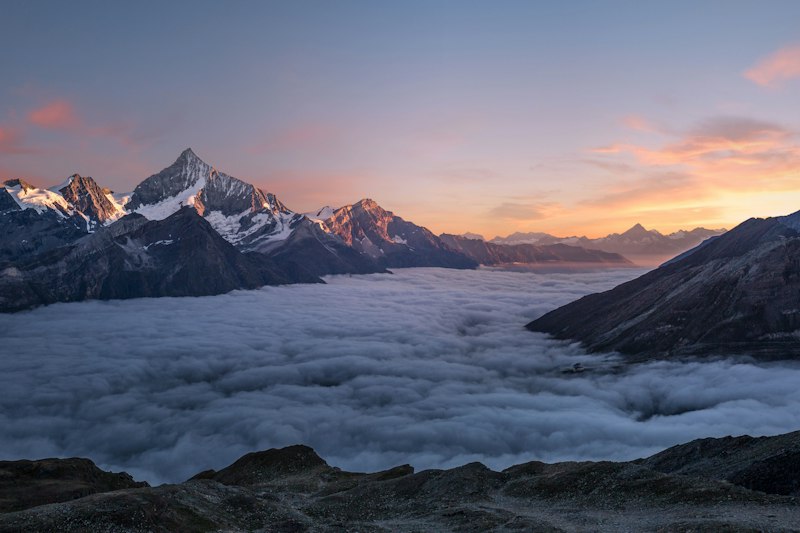
Best time: Sunset, when the peaks glow with alpenglow and the lakes reflect the fading sky.
Access: Funicular from Interlaken to Harder Kulm (10 minutes).
4. Saentis Panorama
The Saentis (2,502m) in the Alpstein massif of Appenzell offers a 360-degree panorama that encompasses six countries on clear days. The observation platform provides unobstructed views in every direction, and the limestone ridges of the Alpstein create dramatic foreground elements.
Best time: Early morning in autumn for the clearest air and most dramatic light. Winter provides snow-covered ridges and temperature inversions.
Access: Cable car from Schwaegalp to the summit.
5. Pilatus from Lucerne
Mount Pilatus rises directly behind Lucerne, creating a dramatic backdrop visible from the lakefront, the Chapel Bridge, and the old town. The mountain's jagged limestone ridges are particularly photogenic when dusted with fresh snow or silhouetted against sunset colors.
Best time: Late afternoon from the Lucerne lakefront, or sunrise from the Pilatus summit (staying at Hotel Pilatus-Kulm allows pre-dawn access).
Access: Boat to Alpnachstad, then the world's steepest cogwheel railway; or cable car from Kriens.
Lakes and Reflections
6. Lake Oeschinen (Oeschinensee)
Turquoise water surrounded by sheer cliffs and waterfalls, with reflections of the Bluemlisalp massif. The dramatic cirque setting makes every photograph look like a composite.
Best time: Morning for calm water and cliff reflections. June-September for the most intense turquoise color.
Access: Gondola from Kandersteg, then 20-minute walk to the lakeshore.
7. Lake Brienz at Iseltwald
The tiny peninsula village of Iseltwald on Lake Brienz has become famous for its photogenic dock and boathouse set against improbably turquoise water. The village appeared in a popular streaming series and subsequently became one of Switzerland's most photographed spots.
Best time: Early morning for calm water and soft light, before day-trip crowds arrive.
Access: Boat from Interlaken or Brienz, or bus from Interlaken.
8. Bachalpsee
The alpine lake above Grindelwald that reflects the Eiger, Schreckhorn, and Wetterhorn. On still mornings, the reflections are flawless, creating symmetrical compositions that have become defining images of the Swiss Alps.
Best time: Early morning (8-9 AM, first gondola) for still water. July-September for best conditions.
Access: First gondola from Grindelwald, then 50-minute walk.
9. Blausee
A small lake of supernatural blue clarity in the Bernese Oberland. The water is so transparent that the bottom is visible at ten meters, and sunlight creates shifting patterns on the lakebed. The surrounding forest provides framing elements for intimate landscape photography.
Best time: Midday when sunlight penetrates the water most deeply, creating the most vivid blue.
Access: Train to Frutigen, then PostBus toward Kandersteg.
10. Caumasee (Flims)
A hidden lake near Flims in Graubunden, accessible only on foot through a short forest path. The water is Caribbean-turquoise, surrounded by limestone cliffs and dense forest. An elevator carved through the rock provides access to the lakeshore.
Best time: Morning in summer for the warmest light on the turquoise water.
Access: 20-minute walk from Flims village center.
11. Lake Lugano from Monte San Salvatore
The view from Monte San Salvatore (912m) above Lugano sweeps across the Italian-influenced lake town, the surrounding mountains, and the branching arms of Lake Lugano extending toward Italy. The Mediterranean architecture and subtropical vegetation create a distinctly different Swiss landscape.
Best time: Sunset, when the lake turns golden and the mountain shadows lengthen.
Access: Funicular from Paradiso (suburb of Lugano) to the summit.
12. Lake Geneva from Lavaux
The UNESCO-listed vineyard terraces of Lavaux descend to the shores of Lake Geneva with the Savoy Alps and Mont Blanc visible across the water. The geometric patterns of the terraces, the villages nestled between the vines, and the alpine backdrop create layered compositions of extraordinary beauty.
Best time: Autumn (September-October) when the vines turn gold and red. Late afternoon for warm lateral light.
Access: Any lakeside train stop between Lausanne and Montreux.
Waterfalls
13. Staubbach Falls (Lauterbrunnen)
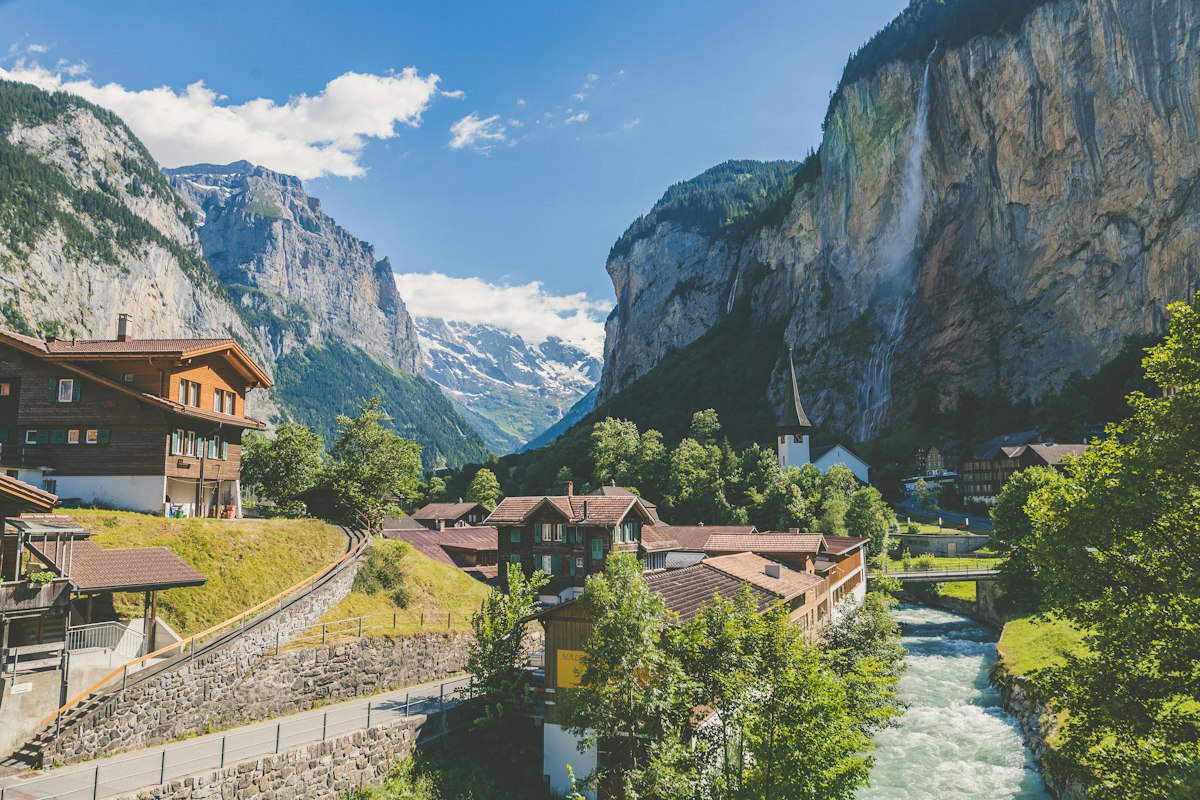
A 297-meter free-falling waterfall that drops directly into the village of Lauterbrunnen. On sunny mornings, rainbows form in the spray, and the waterfall can be photographed with the village and valley as foreground.
Best time: Morning for rainbows; summer for maximum water flow.
Access: Walk from Lauterbrunnen village center (the falls are visible from the main street).
14. Trummelbach Falls
Ten glacial waterfalls thundering inside a mountain in the Lauterbrunnen valley. The waterfalls are illuminated and accessible via elevator and walkways inside the rock. The combination of water power, sound, and enclosed space creates opportunities for dramatic long-exposure photography.
Best time: Summer (June-September) for maximum water flow. The interior lighting creates consistent conditions.
Access: Bus from Lauterbrunnen, or walk from Stechelberg.
15. Rhine Falls (Schaffhausen)
Europe's largest waterfall by volume: 150 meters wide and 23 meters high, with an average flow of 600 cubic meters per second. The scale is impressive, and the viewing platforms on both banks and the rock in the center of the falls allow varied compositions.
Best time: Late afternoon for dramatic side-lighting. Spring (April-May) for maximum water volume after snowmelt.
Access: Train to Schloss Laufen am Rheinfall or Neuhausen am Rheinfall.
16. Giessbach Falls
Seven cascading tiers of waterfall dropping 500 meters through forest to Lake Brienz. A historic funicular connects the lake to the Grandhotel Giessbach, which sits beside the falls. The combination of the Belle Epoque hotel, the tiered waterfall, and the lake below creates a fairy-tale scene.
Best time: Late afternoon when sunlight filters through the forest. The falls are illuminated at night for a different effect.
Access: Boat from Brienz to Giessbach landing, then funicular to the hotel.
17. Simmenfaelle (Lenk)
A powerful waterfall in the Simmental valley, cascading over moss-covered rocks in a dense forest setting. Less famous than other Swiss waterfalls, the Simmenfaelle offers intimate forest photography with excellent conditions for long exposures.
Best time: Overcast days for even light on the water and moss. Spring for maximum flow.
Access: Short walk from the Siebenbrunnen stop on the Lenk PostBus.
Picturesque Villages
18. Lauterbrunnen Valley
The U-shaped glacial valley with 300-meter vertical cliffs, 72 waterfalls, and the villages of Lauterbrunnen, Wengen, Murren, and Gimmelwald. The valley is photogenic from every angle and in every season.
Best time: Morning when sunlight enters the valley and illuminates the waterfalls.
19. Stein am Rhein
The most perfectly preserved medieval town in Switzerland, with every building in the central square featuring elaborate 16th-century frescoes. The combination of painted facades, half-timbered architecture, and the clear Rhine flowing through creates a scene of almost excessive beauty.
Best time: Morning for soft light on the frescoes without harsh shadows.
Access: Train from Zurich (1 hour 10 minutes).
20. Gruyeres
A hilltop medieval village with a single cobblestoned main street leading to a 13th-century castle. The surrounding green hills, with the pre-Alps as backdrop, create a pastoral Swiss scene that could illustrate a fairy tale.
Best time: Early morning before day-trip visitors arrive. Misty autumn mornings are especially atmospheric.
Access: Train to Gruyeres station, then uphill walk.
21. Morcote (Lake Lugano)
An Italianate lakeside village with arcaded houses, subtropical gardens, and a hilltop church. The Mediterranean architecture clinging to steep shores creates compositions that look more Amalfi Coast than Swiss Alps.
Best time: Golden hour light on the lakefront facades. The approach by boat provides the most photogenic views.
Access: Boat from Lugano.
22. Gandria (Lake Lugano)
A tiny fishing village accessible only by boat or foot, where houses cascade down a steep slope to the lake. The absence of car access has preserved an atmosphere of timeless tranquility.
Best time: Afternoon, when the west-facing facades glow in warm light.
Access: Boat from Lugano or lakeside walking path.
23. Iseltwald
The picturesque village on Lake Brienz with its famous wooden dock and boathouse. The turquoise lake water and mountain backdrop create compositions of striking color contrast.
Best time: Early morning for calm lake conditions and fewer visitors.
24. Guarda (Engadin)
A beautifully preserved Engadin village with sgraffito-decorated facades -- traditional ornamental plasterwork unique to the region. The geometric patterns on the whitewashed buildings, combined with the flower boxes and mountain backdrop, create a distinctly Engadin aesthetic.
Best time: Any time of day; the sgraffito patterns photograph well in various light conditions.
Access: Train to Guarda station on the Rhaetian Railway.
25. Appenzell
A village of painted facades, traditional cheese shops, and folk-art decorations in the rolling green hills of northeastern Switzerland. The colorful buildings against the backdrop of the Alpstein massif create vibrant, joyful compositions.
Best time: Market days for additional color and activity.
Access: Train from Zurich (2 hours with change at Gossau).
Cities
26. Chapel Bridge, Lucerne
The oldest covered wooden bridge in Europe (dating to 1333), with the Water Tower and the old town buildings reflected in the River Reuss. Mount Pilatus provides a dramatic mountain backdrop.
Best time: Blue hour (just after sunset) when the bridge lights are on and the sky retains color.
27. Bern Old Town from Rosengarten
The UNESCO-listed medieval old town of Bern, viewed from the Rose Garden above the Aare river bend. The distinctive green-copper rooftops, the cathedral spire, and the alpine skyline beyond create one of the most recognizable cityscape photographs in Switzerland.
Best time: Late afternoon for warm light on the sandstone buildings.
28. Zurich Limmat Quai
The Zurich old town reflected in the Limmat River, with the towers of the Grossmuenster, Fraumuenster, and St. Peters Church creating a skyline that defines the city. The view from the Rathausbruecke or Gemusebruecke is the classic composition.
Best time: Blue hour for city lights reflecting in the river.
29. Basel Rhine Panorama
The view from the Pfalz terrace behind the Basel Minster, looking across the Rhine to Kleinbasel. The river, the medieval old town, and the modern architecture of the Roche Tower create a composition that captures Basel's blend of old and new.
Best time: Sunset for warm light on the cathedral and reflections in the Rhine.
30. Geneva Jet d'Eau
The iconic 140-meter water jet on Lake Geneva, with the Mont Blanc bridge, the old town, and the Jura mountains as background elements. The jet creates a dynamic focal point that photographs well from multiple angles.
Best time: Late afternoon for backlit spray effects, or sunset for dramatic sky colors.
Scenic Railways and Bridges
31. Landwasser Viaduct (Bernina Express)
The most photographed railway bridge in the world: a 65-meter-high, six-arch curved stone viaduct on the Rhaetian Railway between Filisur and Tiefencastel. Trains emerge from a tunnel directly onto the curved bridge, creating a dramatic moment of engineering beauty.
Best time: Any time a train is crossing. The viewing platform is accessible by a short hike from the Filisur side.
Access: Hike from Filisur station (30 minutes) or view from the train itself.
32. Gotthard Pass Road
The historic Gotthard Pass road features cobblestone switchbacks that create dramatic S-curves photographed from above. The old road (separate from the modern highway tunnel) is open June through October and is one of the most photogenic mountain roads in the Alps.
Best time: Autumn for golden larch trees alongside the switchbacks.
33. Glacier Express on the Oberalp Pass
The red Glacier Express train crossing snow-covered mountain terrain near the Oberalp Pass (2,033m). The contrast of the red train against white snow and blue sky is one of the defining images of Swiss winter tourism.
Best time: Winter for snow coverage, clear winter days for best contrast.
34. Centovalli Railway
The narrow-gauge railway between Locarno and Domodossola crosses deep gorges on dramatic bridges, passing through chestnut forests and tiny villages. The route is less famous than the Bernina Express but equally photogenic.
Best time: Autumn for chestnut forest colors.
35. Bruenig Pass Railway
The rack railway between Lucerne and Interlaken crosses the Bruenig Pass with views of Lake Brienz far below. Photographing the train from trackside viewpoints captures the combination of engineering and landscape.
Hidden Viewpoints and Unique Spots
36. Creux du Van
The 160-meter-deep natural amphitheater in the Jura mountains, with ibex often visible on the cliff edges. The semicircular rock face, seen from the rim, creates compositions of geological drama.
Best time: Morning mist rising from the amphitheater floor. Autumn for ibex activity.
37. Aletsch Glacier from Eggishorn
The view of the 23-kilometer Aletsch Glacier from the Eggishorn (2,927m) is the most dramatic glacier photograph in the Alps. The river of ice stretching to the horizon, flanked by rocky moraines and snow-covered peaks, conveys the scale of alpine glaciation.
Best time: Morning for best light on the glacier. September-October for clear air.
Access: Cable car from Fiesch to Eggishorn summit.
38. Verzasca Valley (Ponte dei Salti)
The medieval double-arched stone bridge at Lavertezzo, spanning the crystal-clear Verzasca River. The water's emerald and turquoise colors against the grey stone create striking color contrasts.
Best time: Midday when sunlight penetrates the water, enhancing the turquoise color.
39. Cresta Run / Frozen Lakes (Engadin)
The frozen lakes of the Upper Engadin (Silvaplana, Sils, St. Moritz) in winter, with snow-covered peaks reflected in ice and the characteristic Engadin light. Horse racing and polo on the frozen lakes provide unique action photography opportunities.
Best time: January-February for frozen lake conditions and the Snow Polo World Cup.
40. Grindelwald First Cliff Walk
The suspended walkway at First, extending over the cliff edge with the Eiger as backdrop. The metal and glass walkway creates leading lines and dramatic foreground elements for mountain photography.
41. Schynige Platte Botanical Garden
An alpine botanical garden at 2,000 meters above Interlaken, with curated displays of Swiss alpine flowers against the backdrop of the Eiger, Moench, and Jungfrau. The combination of macro flower photography and epic mountain panoramas is unique.
Best time: June-July for peak wildflower blooming.
42. Harder Kulm Two Lakes Bridge
The glass-bottomed viewing platform at Harder Kulm, Interlaken, positioned to show Lake Thun and Lake Brienz simultaneously. The aerial perspective and the glass floor create vertigo-inducing compositions.
43. Stanserhorn CabriO Cable Car
The world's first open-top cable car, ascending to the Stanserhorn summit. Photographing fellow passengers standing on the open upper deck with the Alpine panorama behind them creates unique travel photographs.
44. Aare River Swimming, Bern
Bernese locals swimming in the turquoise Aare River through the city center in summer. The contrast of swimmers in clear glacial water against the medieval old town backdrop is distinctly Bernese.
45. Augustinergasse, Zurich
The narrow medieval lane with projecting bay windows and flower boxes, often cited as the most photogenic street in Zurich. The medieval architecture creates natural framing and leading lines.
46. Swiss National Park (Engadin)
Switzerland's only national park, near Zernez in the Engadin. Wild landscapes, ibex, marmots, and golden eagles provide wildlife photography opportunities in an alpine setting.
47. Niederhorn Sunset
The Niederhorn above Lake Thun offers sunset panoramas across the Bernese Alps with Lake Thun in the foreground. The cable car runs late in summer, allowing photographers to capture golden hour and blue hour from the summit.
48. Chateau de Chillon
The medieval castle on a rocky island in Lake Geneva, with the Dents du Midi mountains as backdrop. The castle's reflection in calm lake water creates a composition that has inspired artists and photographers for centuries.
Best time: Early morning or late afternoon for warm light on the stone walls.
49. Swiss Alpine Passes (Furka, Susten, Grimsel)
The high mountain passes of Central Switzerland offer dramatic road photography with hairpin switchbacks, glacial views, and vast alpine emptiness. The Furka Pass road (featured in the James Bond film Goldfinger) is particularly photogenic.
Best time: June-October (passes are closed in winter). Early morning for clean light without traffic.
50. Appenzell Rolling Hills
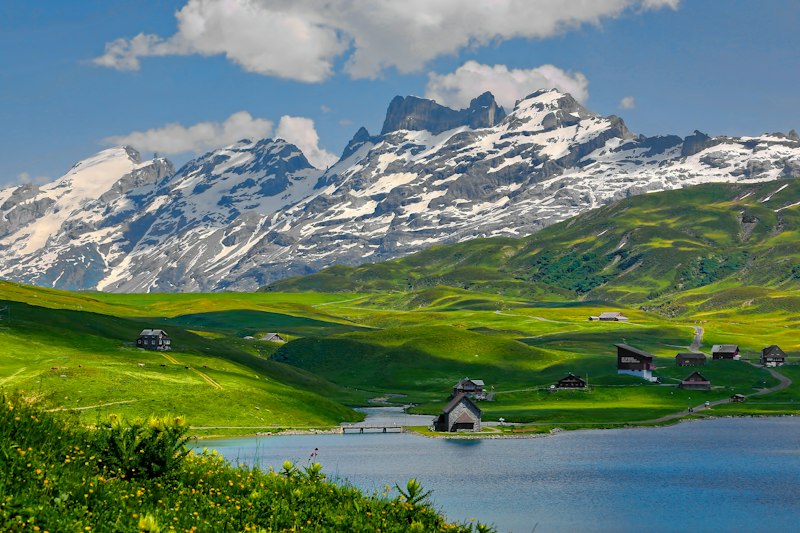
The green, undulating landscape of Appenzell, with scattered farmhouses, flower meadows, and the Alpstein massif rising dramatically behind. This pastoral Swiss landscape represents the idealized image of Alpine farming country.
Best time: May-June for green meadows and wildflowers. Morning for misty, atmospheric conditions.
Photography Tips
Light
The quality of light in Switzerland is exceptional. At altitude, the air is thin and clean, producing intense colors and sharp contrast. The best light for landscape photography is in the first and last hours of daylight (golden hour), but the midday Alpine sun also produces vivid colors, particularly on lakes and snow.
Weather
Check MeteoSwiss forecasts before planning photography excursions. The presence or absence of clouds dramatically affects mountain photography. Partly cloudy conditions often produce the most dramatic images, with light breaking through gaps to illuminate selected peaks or valleys.
Seasons
Each season offers distinct opportunities. Summer brings green meadows and long golden hours. Autumn offers larch forests turning gold and the clearest air of the year. Winter provides snow-covered landscapes and dramatic weather. Spring brings wildflowers and waterfalls at peak flow.
Gear Recommendations
A versatile zoom lens (24-105mm equivalent) covers most Swiss landscape situations. A wide-angle lens (16-35mm) is essential for mountain panoramas and interior shots. A polarizing filter enhances lake and sky colors. A lightweight tripod enables long exposures of waterfalls and blue-hour cityscapes.
For more travel planning, explore our destination guides or browse our hiking trails.
About the Author
"ch.tours Editorial"
Travel Editorial
The ch.tours editorial team is made up of travel experts and locals who share their passion for Switzerland. We deliver up-to-date, practical travel advice based on first-hand experience.