The Jungfrau region is the crown jewel of the Swiss Alps. Dominated by the three legendary peaks of the Eiger (3,967m), Moench (4,107m), and Jungfrau (4,158m), this compact area in the Bernese Oberland packs more spectacular scenery, dramatic mountain experiences, and charming Alpine villages into a single region than anywhere else in Switzerland.
Whether you want to ride a train through the inside of a mountain to Europe's highest railway station, hike through meadows bursting with wildflowers beneath sheer cliff faces, paraglide over glacier-carved valleys, or simply sit on a terrace with a coffee and stare at scenery that defies belief, the Jungfrau region delivers.
This guide covers everything you need to plan a trip: the best villages to stay in, the top excursions, hiking routes, practical transport information, and the honest advice that helps you make the most of your time and budget.
Region Overview
The Jungfrau region sits within the larger Bernese Oberland, approximately 70 kilometers south of Bern. The gateway town is Interlaken, positioned between Lake Thun and Lake Brienz at the base of the mountains. From Interlaken, two valleys lead into the heart of the region:
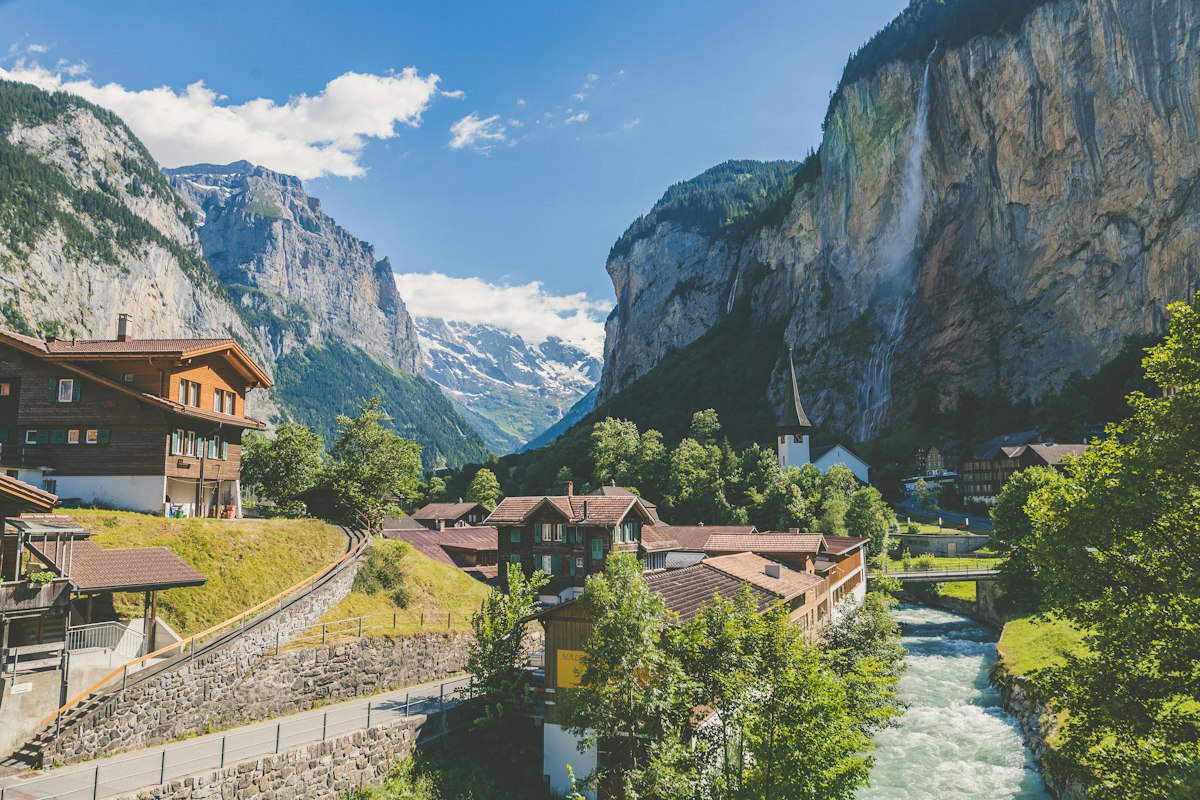
The Lauterbrunnen Valley extends south from Interlaken, flanked by 300-meter vertical cliffs and over 70 waterfalls. The village of Lauterbrunnen sits on the valley floor, while Wengen and Murren are car-free villages perched on the cliffs above.
The Grindelwald Valley branches southeast from Interlaken toward the base of the Eiger's infamous North Face. Grindelwald is the largest village in the region and the main hub for the Jungfraujoch railway and the new Eiger Express gondola.
The two valleys are connected at their upper end by the Kleine Scheidegg pass, which serves as the junction station for the Jungfraujoch railway. This circular geography means you can enter the region via one valley and return via the other, creating a natural loop.
The Villages
Interlaken
Interlaken is the transportation hub and commercial center, not the alpine village experience itself. It is a practical base with good connections, a wide range of hotels, and an adventure sports industry centered on paragliding, canyoning, and bungee jumping. The town itself is pleasant but modern, with the Hoehematte (a large central meadow) providing open views of the Jungfrau.
Stay here if: You want maximum convenience, budget accommodation options, and easy access to both valleys. Interlaken has the widest range of hostels, budget hotels, and restaurants in the region.
Skip if: You want authentic alpine atmosphere. The village itself can feel commercialized, and you will spend time commuting into the mountains each morning.
Grindelwald
Grindelwald is the largest and most developed village in the Jungfrau region, with a population of about 4,000 and a substantial tourist infrastructure. It sits at 1,034 meters in a sunny valley directly below the Eiger North Face, surrounded by glaciers, waterfalls, and meadows.
The village offers the most complete range of services: supermarkets, restaurants, sports shops, a year-round ski and adventure sports scene, and direct access to both the Jungfraujoch (via the Eiger Express gondola) and the First mountain area.
The new V-Cableway development has transformed Grindelwald into the primary access point for Jungfraujoch. The Eiger Express gondola, opened in 2020, takes passengers from Grindelwald terminal to the Eigergletscher station in just 15 minutes, cutting the total journey time to Jungfraujoch by approximately 45 minutes compared to the traditional route from Lauterbrunnen.
Stay here if: You want a vibrant village with the widest range of activities, good restaurants and nightlife, and the fastest access to Jungfraujoch. Grindelwald is the best base for families with older children and teenagers.
Lauterbrunnen
Lauterbrunnen is where the Jungfrau region reveals its most dramatic face. The village sits on the floor of a U-shaped glacial valley flanked by vertical cliffs that Tolkien reportedly used as inspiration for Rivendell. The Staubbach Falls plunge 297 meters from the cliff top directly into the village, and on sunny mornings, rainbows form in the spray.
The village itself is small and traditional, with a handful of hotels, restaurants, and shops along the main street. It serves as the junction point for the mountain railways to Wengen and Murren, making it a natural hub for exploring the region.
Camping in Lauterbrunnen is legendary. The valley campsites (Camping Jungfrau, Camping Schutzenbach) offer some of the most spectacular camping in the world -- waking up in a tent surrounded by 300-meter cliffs and waterfalls is an experience that no hotel can replicate.
Stay here if: You want dramatic scenery at your doorstep, a traditional alpine atmosphere, and convenient access to both Wengen/Jungfraujoch and Murren/Schilthorn. The campgrounds make it the best budget option in the region.
Wengen
Wengen is a car-free village at 1,274 meters on a sunny ledge above the Lauterbrunnen valley, accessible only by the Wengernalpbahn rack railway from Lauterbrunnen. The absence of cars gives it a serenity that larger villages lack -- the only sounds are cowbells, birdsong, and the occasional clatter of the cogwheel train.
The village is the traditional starting point for the Jungfraujoch journey (though the new Eiger Express from Grindelwald is now faster). It offers excellent hiking, a charming collection of Belle Epoque hotels, and unobstructed views of the Lauterbrunnen valley and the Jungfrau massif.
Stay here if: You want a car-free alpine village with elegant hotels, a peaceful atmosphere, and direct access to the Jungfraujoch railway. Wengen is ideal for couples and travelers who value tranquility.
Murren
If Wengen is serene, Murren is otherworldly. This car-free village at 1,650 meters clings to a cliff edge opposite the Eiger, Moench, and Jungfrau, with views so commanding that they make you question whether you are looking at reality or a painting. The panorama from Murren is arguably the finest village view in the Alps.
Murren is reached by cable car from Stechelberg (in the Lauterbrunnen valley) or by train from Lauterbrunnen via Gruetschalp. It serves as the base for the Schilthorn cable car, which ascends to the revolving restaurant at 2,970 meters -- made famous as a James Bond filming location in On Her Majesty's Secret Service.
The village is small, with a handful of hotels, restaurants, and the Sportzentrum (sports center with pool and climbing wall). It has a lively but intimate atmosphere, particularly during ski season when the uncrowded slopes attract dedicated skiers who prefer terrain over luxury.
Stay here if: You want the most dramatic views in the region, a genuine car-free alpine village, and access to the Schilthorn. Murren is perfect for hikers and anyone who values scenery above all else.
Top Excursions
Jungfraujoch -- Top of Europe (3,454m)
The most famous mountain excursion in Switzerland. A cogwheel train climbs through the inside of the Eiger to emerge at Europe's highest railway station, where an observation platform, ice palace, and year-round snow activities await.
The views from the Sphinx observation deck -- across the Aletsch Glacier (the longest in the Alps) to peaks in four countries -- are extraordinary on clear days. Allow 4-5 hours for the round trip, including time at the top.
Cost: CHF 240 round trip from Interlaken (50% off with Swiss Travel Pass). The Eiger Express from Grindelwald is the fastest route.
Tip: Check the webcams before going. Jungfraujoch is above the clouds on many days, and the experience is dramatically diminished when visibility is poor. Go on a clear morning for the best conditions.
Schilthorn -- Piz Gloria (2,970m)
The Schilthorn offers a 360-degree panorama from a revolving restaurant made famous by the James Bond film. On clear days, you can see the Eiger, Moench, Jungfrau, Mont Blanc, and peaks in Germany's Black Forest -- a span of over 200 kilometers.
The cable car from Murren (or Stechelberg) takes approximately 30 minutes each way. The Thrill Walk at Birg (an intermediate station) adds a cliff-edge walkway experience along the rock face.
Cost: CHF 108 round trip from Murren, CHF 138 from Stechelberg (50% off with Swiss Travel Pass).
First -- Top of Adventure (2,168m)
Grindelwald's family-friendly mountain, accessed by gondola. First offers the First Cliff Walk (a suspended walkway along a cliff face), First Flyer (a 800-meter zip line), First Glider (a hang-glider-style ride), and the Trottibike (a scooter descent back to Grindelwald).
For hikers, First is the starting point for the spectacular Bachalpsee trail -- a gentle 50-minute walk to a crystal-clear alpine lake with the Eiger reflected in its waters. This is one of the most photographed spots in Switzerland and is accessible to walkers of all fitness levels.
Cost: CHF 66 round trip from Grindelwald (50% off with Swiss Travel Pass).
Harder Kulm (1,322m)
The easiest and cheapest panoramic viewpoint in the region. A funicular from Interlaken climbs to Harder Kulm in 10 minutes, arriving at a viewing platform that juts out over the edge of the cliff with 360-degree views of Interlaken, both lakes, and the entire Jungfrau massif.
The Two Lakes Bridge viewing platform is particularly dramatic, offering simultaneous views of Lake Thun and Lake Brienz far below.
Cost: CHF 34 round trip (free with Swiss Travel Pass).
Best Hikes
The Jungfrau region offers hiking for every level, from gentle valley walks to challenging high-altitude routes. Here are five standout trails:
Bachalpsee from First (Easy, 1.5 hours round trip)
The classic Jungfrau hike. A gentle, well-maintained path leads from the First gondola station to the Bachalpsee, a pristine alpine lake at 2,265 meters. On calm days, the Eiger and Schreckhorn are perfectly reflected in the water. This trail is accessible to anyone who can walk on relatively flat ground for an hour.
North Face Trail, Grindelwald (Easy-Moderate, 2 hours)
A panoramic trail from Alpiglen station to Kleine Scheidegg, traversing meadows directly below the Eiger North Face. The proximity to the legendary wall is humbling -- you can see individual climbers on the face with binoculars. The trail is well-maintained and mostly gentle, with a few steeper sections.
Lauterbrunnen Valley Walk (Easy, 1-2 hours)
A flat walk along the valley floor from Lauterbrunnen to Stechelberg, passing multiple waterfalls and framed by 300-meter cliffs on both sides. This is an all-weather, all-season walk suitable for families with strollers and is arguably the most dramatic easy walk in the Alps.
Schynige Platte to First (Challenging, 6-7 hours)
One of the greatest high-altitude hikes in Switzerland. The trail traverses the ridge between the Schynige Platte and First, maintaining an altitude of around 2,000-2,300 meters with continuous panoramic views of the Eiger, Moench, Jungfrau, and both lakes. The trail is well-marked but long and requires good fitness and mountain experience.
Murren to Gimmelwald via Sefinental (Moderate, 3-4 hours)
A beautiful circuit from Murren descending into the wild Sefinental valley and through the tiny village of Gimmelwald (population 130), which Rick Steves once famously described as his favorite place in the Alps. The trail passes through forest, alpine meadows, and working farmland, with the Jungfrau massif as a constant backdrop.
Getting Around
Rail Network
The Jungfrau region has a comprehensive mountain railway network operated by Jungfraubahn:
- BOB (Berner Oberland-Bahn): Interlaken Ost to Lauterbrunnen and Grindelwald
- WAB (Wengernalpbahn): Lauterbrunnen to Wengen to Kleine Scheidegg, and Grindelwald to Kleine Scheidegg
- JB (Jungfraubahn): Kleine Scheidegg to Jungfraujoch
- Eiger Express: Grindelwald terminal to Eigergletscher (gondola)
- BLM (Bergbahn Lauterbrunnen-Muerren): Lauterbrunnen to Gruetschalp to Murren
- LSMS (Schilthornbahn): Stechelberg to Murren to Schilthorn
The Swiss Travel Pass covers BOB, WAB, and BLM (as regular rail services). Mountain excursions (Jungfraujoch, Schilthorn, First) require additional tickets but receive a 50% discount with the Swiss Travel Pass.
Recommended Loop
A classic day in the Jungfrau region follows this loop:
Interlaken -- train to Lauterbrunnen -- train up to Wengen -- train to Kleine Scheidegg (optional: continue to Jungfraujoch) -- train down to Grindelwald -- train back to Interlaken.
This loop takes you through both valleys and hits the major scenic highlights. It can be done in a day or spread over two days with an overnight in Wengen, Murren, or Grindelwald.
Where to Stay
Budget: Lauterbrunnen
The valley campgrounds offer the cheapest beds in the region (CHF 15-25 per person for tent camping). The Valley Hostel and Mountain Hostel in Gimmelwald provide budget dorm beds (CHF 35-50) in stunning locations.
Mid-Range: Grindelwald
Grindelwald has the widest range of mid-range hotels and apartments. Properties like Hotel Kirchbuhl, Parkhotel Schoenegg, and the many apartment rentals available through local agencies offer comfortable rooms with mountain views for CHF 150-250 per night.
Splurge: Murren or Wengen
For the ultimate alpine experience, the car-free villages reward a premium. Hotel Eiger in Murren and Hotel Regina in Wengen offer classic Swiss hospitality with panoramic views, excellent restaurants, and the peace of car-free surroundings. Expect CHF 250-400 per night, but the setting is incomparable.
How Many Nights
For a comprehensive Jungfrau experience, plan 3-4 nights. This allows time for Jungfraujoch or Schilthorn (1 day), a full day of hiking (1 day), and exploring the villages and valley (1-2 days). Two nights is the minimum for a meaningful visit; five nights allows a deep, relaxed exploration with time for rest days and weather flexibility.
Practical Tips
Weather: Mountain weather changes rapidly. Always check forecasts before excursions and carry rain gear even on sunny mornings. The webcams at Jungfraujoch, Schilthorn, and First give real-time conditions.
Crowds: July and August are the busiest months. For the best experience, visit in June or September. On any day, starting early (before 9 AM) avoids the worst crowds at Jungfraujoch and other popular excursions.
Altitude: Jungfraujoch (3,454m) is high enough for altitude effects. Drink water, move slowly, and descend if you experience headaches or dizziness. Most visitors have no problems, but those with respiratory or cardiac conditions should consult a doctor before visiting.
Budget: The Jungfrau region is expensive even by Swiss standards. Mountain railway tickets add up quickly. Budget travelers should focus on hiking (free) and select one or two paid excursions rather than trying to do everything.
For more destination guides, visit our destinations section or explore our Bernese Oberland itineraries.
About the Author
"ch.tours Editorial"
Travel Editorial
The ch.tours editorial team is made up of travel experts and locals who share their passion for Switzerland. We deliver up-to-date, practical travel advice based on first-hand experience.